Print
Print
 Create flyer
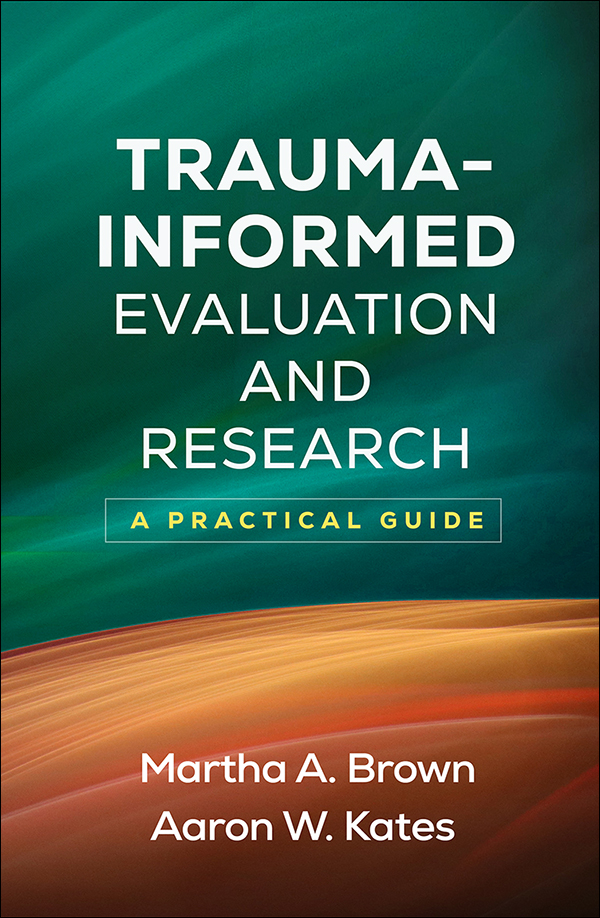
Trauma-Informed Evaluation and Research
A Practical Guide
Martha A. Brown and Aaron W. Kates
HardcoverPaperbacke-bookprint + e-book
Hardcover
pre-orderSeptember 17, 2026
ISBN 9781462563531
Price: $71.00 242 Pages
Size: 7" x 10"
Paperback
pre-orderAugust 20, 2026
ISBN 9781462563524
Price: $47.00242 Pages
Size: 7" x 10"
e-book
pre-orderAugust 20, 2026
PDF and Accessible ePub ?
Price: $47.00 242 Pages
ePub is Global Certified Accessible
print + e-book $94.00 $56.40
pre-orderPaperback + e-Book (PDF and Accessible ePub) ?
Price: 242 Pages
ePub is Global Certified Accessible
 Digital professor copy available on VitalSource once published ?
Sign up for emails on upcoming titles on Trauma & PTSD (with special discounts)!
“Trauma-informed care has led to innovations in programs and practices, but guidance for conducting TIER has largely been lacking. This book fills a gap by offering clear, actionable instruction on applying TIER across settings where trauma-informed approaches are needed. The authors adopt a strengths-based perspective and address challenging issues with clarity and rigor. Case studies and reflection prompts make the content directly useful to practitioners, evaluators, and researchers.”

—Emily Adlin Bosk, LMSW, PhD, School of Social Work, Rutgers, The State University of New Jersey; originator of the TIER framework
“A comprehensive conceptual and methodological resource for evaluators and practitioners who work with populations that have experienced significant trauma. This book explains trauma-informed principles and applies them to evaluation scholarship and practice in a thoughtful, sensible way. It is written in a clear and engaging style. The illustrative examples span multiple types and contexts of trauma, which is a key strength of the book.”
—Rebecca Campbell, PhD, University Distinguished Professor of Psychology, Michigan State University
—Emily Adlin Bosk, LMSW, PhD, School of Social Work, Rutgers, The State University of New Jersey; originator of the TIER framework
“A comprehensive conceptual and methodological resource for evaluators and practitioners who work with populations that have experienced significant trauma. This book explains trauma-informed principles and applies them to evaluation scholarship and practice in a thoughtful, sensible way. It is written in a clear and engaging style. The illustrative examples span multiple types and contexts of trauma, which is a key strength of the book.”
—Rebecca Campbell, PhD, University Distinguished Professor of Psychology, Michigan State University